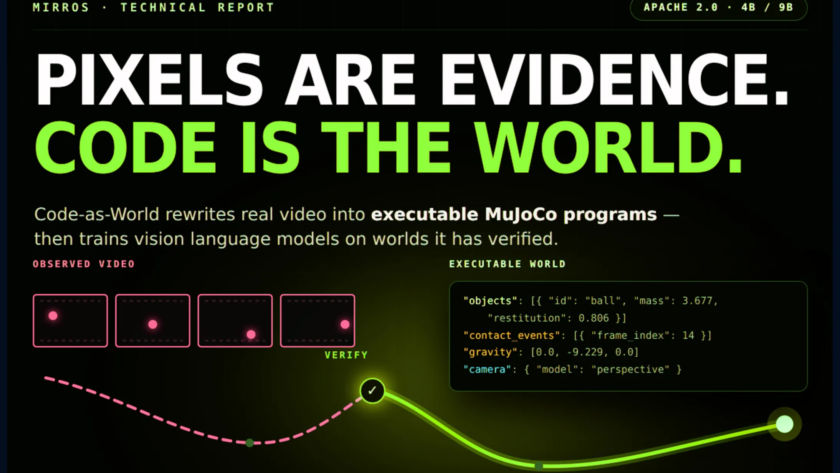
MirroS released Code-as-World: a paradigm that represents physical worlds through executable world representations. The argument is narrow and testable: pixels are evidence of a physical scene, not its ontology. A video model can predict plausible frames without ever representing mass, contact, or gravity. So instead of pixels, latents, or captions, Code-as-World represents a scene as…
Introduction
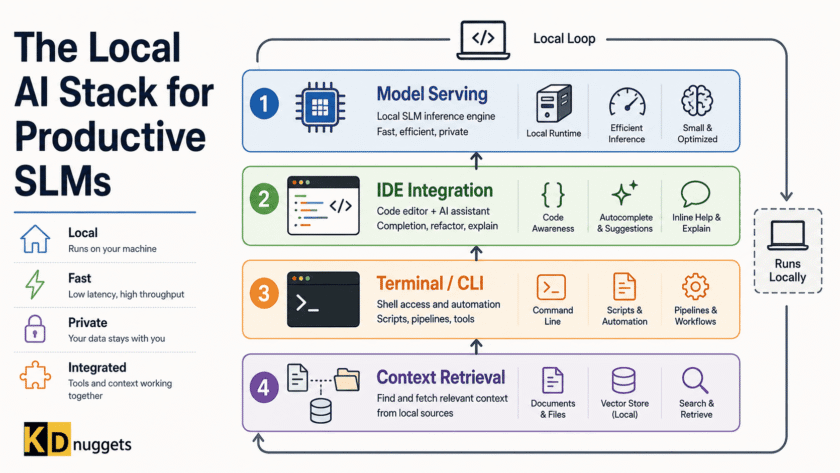
Running a small language model locally is straightforward. Running one productively — inside a real development workflow, with proper context, tool access, and iteration speed — is a different problem entirely.
The gap between "I got a model responding in my terminal" and "I have a local AI setup that actually improves how I…
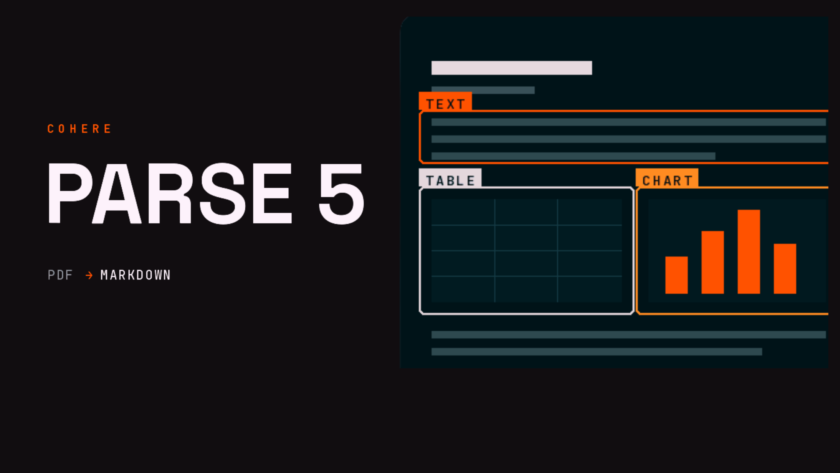
Cohere has released Parse (parse-v5.0), a document parsing model aimed at high-volume enterprise ingestion. It is a 2.3B-parameter vision language model with an 8,192-token context window and a ~4.6GB footprint, built on Cohere Labs’ North-Micro-Vision-Instruct architecture. Parse takes a PDF, PPT or JPEG page as a base64-encoded data URI and returns Markdown containing text in…
Today, we’re introducing Gemini Omni 1.1 Flash, a new suite of creative controls and generative video capabilities to support developers. Gemini Omni brought real-world reasoning to generative creation, and today’s updates make Omni 1.1 production-ready for professional use via the Gemini API in Google AI Studio. Whether you’re building generative video workflows, creative tools, or…
Every day, your organization produces a mountain of words. Support tickets, contracts, clinical notes, customer reviews, emails, call transcripts. Roughly 80% of all enterprise data exists as unstructured text like this — and until recently, almost none of it could be analyzed at scale. It just sat there. Natural Language Processing changed that. And in 2026, with large…
Muse Glimmer is gaining attention in the local AI community and is being compared with Qwen's 27B-class models. In many cases, it is performing better, especially for local coding and agentic workflows.
Meta looks strong in the open-model space, and with a few more iterations, models like this could start competing closely with proprietary systems.…
Object removal models have improved faster than the metrics used to judge them. Diffusion erasers now reconstruct shadows, reflections and occluded structure convincingly, yet PSNR, SSIM, LPIPS, ReMOVE and CFD frequently rank their outputs the wrong way. The root cause is structural: erasure is an ill-posed, one-to-many task, so no single ground truth exists to…
Mathematics is the foundational language of the universe, providing the tools to describe everything from the laws of physics to the intricacies of biology and the logic of computer science. For centuries, its frontiers have been expanded by human ingenuity alone. At Google DeepMind, we believe AI can serve as a powerful tool to collaborate…
An operating system (OS) is the fundamental software that acts as an intermediary between computer hardware and user applications. It manages hardware resources such as the CPU, memory, storage, and input/output devices, while providing essential services like process scheduling, file management, security, and user interfaces. Without an OS, users would need to interact directly with…
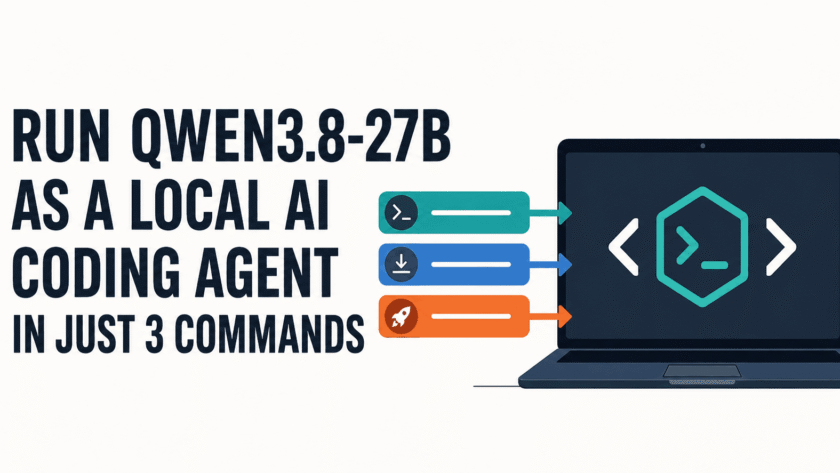
Running a capable 27B model as a local AI coding agent used to mean setting up inference servers, configuring endpoints, and connecting everything manually. With Qwen3.8-27B, Ollama, and OpenCode, the process is now remarkably straightforward.
Qwen3.8-27B is one of the local models I have been most excited to try. It is strong at coding, reasoning,…