Skip to content Skip to sidebar Skip to footer

Developing an End-to-End Document Intelligence Pipeline with docTR for OCR, Layout Analysis, KIE, Benchmarking, and Searchable PDFs

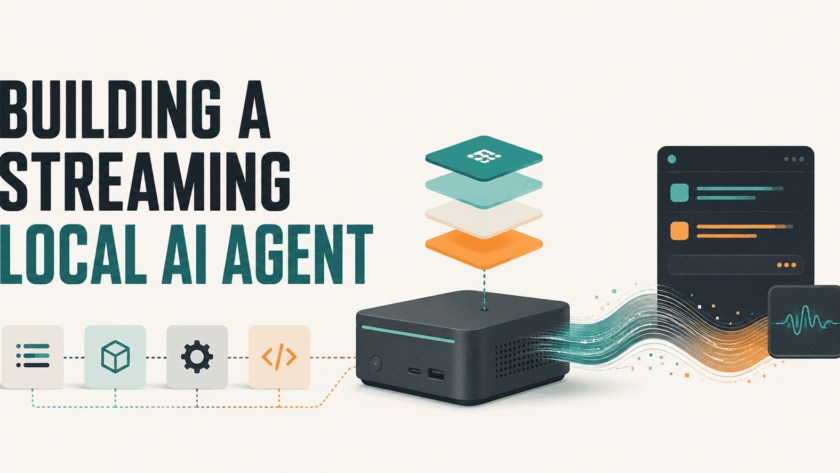
import os, sys, io, json, time, math, re, subprocess, warnings from collections import Counter, defaultdict warnings.filterwarnings("ignore") os.environ.setdefault("USE_TORCH", "1") def _pip(*pkgs): subprocess.run([sys.executable, "-m", "pip", "install", "-q", *pkgs], check=False) try: import doctr except ImportError: print(">> Installing python-doctr (this takes ~1-2 min on Colab)...") _pip("python-doctr[viz]") try: import reportlab except ImportError: _pip("reportlab") import numpy as np import…
Read More

Liquid AI Releases LFM2.5-VL-3B: A 3B Vision-Language Model That Reads Screens, Grounds Objects, and Calls Tools On-Device

Yesterday, Liquid AI released LFM2.5-VL-3B. It is a 3.1B-parameter vision-language model built for on-device deployment. The model reads digital screens across mobile, web, and desktop. It grounds objects to coordinates, parses documents and charts, and calls tools from text or image input. Liquid AI reports an average of 69.4 across 28 vision benchmarks. That matches…

Read More

our most intelligent workhorse model

3.7 Flash shows strong gains over 3.6 Flash in coding tasks like debugging and issue resolution. It also achieves higher first-pass code accuracy and has improved performance in generating production-ready code as seen in FrontierCode 1.1 Main (43.6% vs 34.4%) and DeepSWE v1.1 (65.3% vs 49.0%). In web development, 3.7 Flash generates more functional layouts…

Read More

Dyna Robotics Introduces Dyna-2: A World-Action Model Pre-Trained on 1 Million Hours of Human Video

Dyna Robotics has released Dyna-2, a world-action model for robot manipulation. It was pre-trained on more than one million hours of egocentric human video. That is roughly 170 years of continuous waking experience. Robot learning has been bottlenecked by action-labelled data, which teleoperation must deliberately produce. Dyna-2 tests whether ordinary human video can substitute. The…

Read More

What is RAFT? RAG + Fine-Tuning

In simple terms, retrieval-augmented fine-tuning, or RAFT, is an advanced AI technique in which retrieval-augmented generation is joined with fine-tuning to enhance generative responses from a large language model for specific applications in that particular domain. It allows the large language models to provide more accurate, contextually relevant, and robust results, especially for targeted sectors…

Read More