Skip to content Skip to sidebar Skip to footer

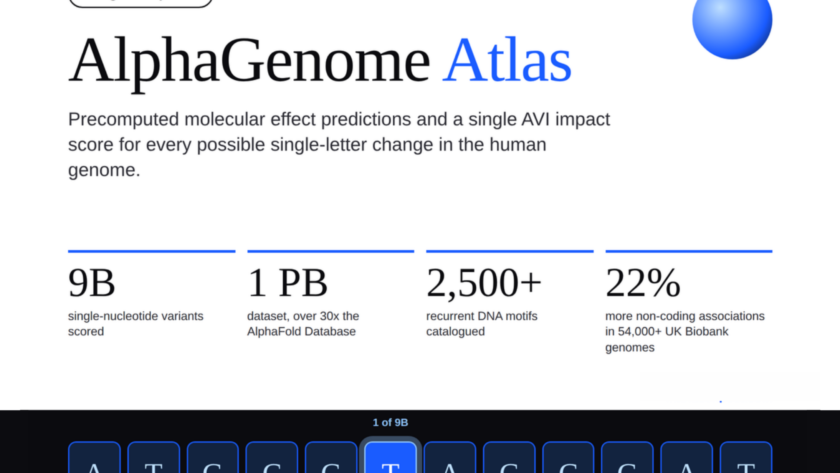
Google DeepMind Releases AlphaGenome Atlas With Precomputed Molecular Effect Predictions and AVI Scores for 9 Billion Human DNA Variants

Google DeepMind has released AlphaGenome Atlas, a catalogue of precomputed predictions for the molecular effects of every possible single-nucleotide variant in the human genome. That is roughly 9 billion single-letter changes. The release also introduces the AlphaGenome Variant Impact (AVI) score, a single number that ranks variants by predicted impact, plus per-variant feature attributions and…
Read More

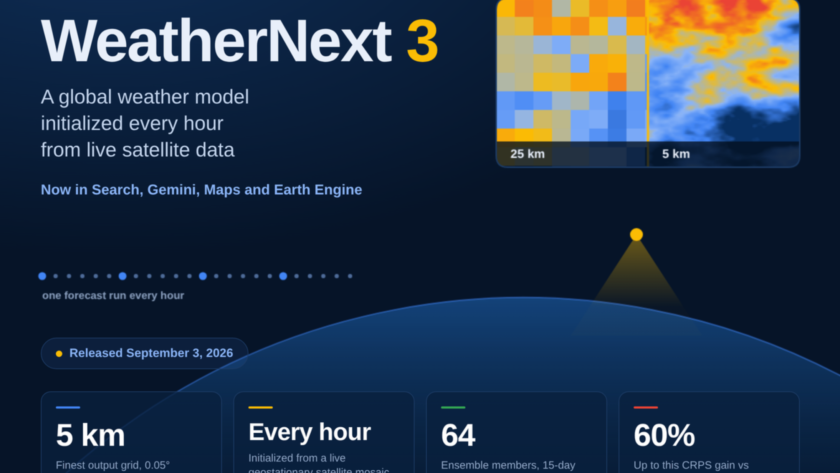
Google DeepMind’s WeatherNext 3 Trains on Weather Station Observations to Deliver 5 km Global Forecasts, Refreshed Every Hour

AI weather models have spent three years closing the gap with physics-based forecasting, but two problems stayed open: resolution too coarse for local terrain, and initialization tied to numerical weather prediction (NWP) analysis that arrives about six hours late. WeatherNext 3, released by Google DeepMind and Google Research, attacks both. It takes a live global…

Read More

Cohere Releases Parse 5 (parse-v5.0): A 2.3B Vision Language Model That Turns Enterprise Documents Into Markdown

Cohere has released Parse (parse-v5.0), a document parsing model aimed at high-volume enterprise ingestion. It is a 2.3B-parameter vision language model with an 8,192-token context window and a ~4.6GB footprint, built on Cohere Labs’ North-Micro-Vision-Instruct architecture. Parse takes a PDF, PPT or JPEG page as a base64-encoded data URI and returns Markdown containing text in…

Read More

Xiaomi’s MiLM Plus Releases PROVE: Perception-Aligned Object Removal Metrics RC-S and RC-T With a Real-World Video Benchmark

Object removal models have improved faster than the metrics used to judge them. Diffusion erasers now reconstruct shadows, reflections and occluded structure convincingly, yet PSNR, SSIM, LPIPS, ReMOVE and CFD frequently rank their outputs the wrong way. The root cause is structural: erasure is an ill-posed, one-to-many task, so no single ground truth exists to…

Read More

Developing an End-to-End Document Intelligence Pipeline with docTR for OCR, Layout Analysis, KIE, Benchmarking, and Searchable PDFs

import os, sys, io, json, time, math, re, subprocess, warnings from collections import Counter, defaultdict warnings.filterwarnings("ignore") os.environ.setdefault("USE_TORCH", "1") def _pip(*pkgs): subprocess.run([sys.executable, "-m", "pip", "install", "-q", *pkgs], check=False) try: import doctr except ImportError: print(">> Installing python-doctr (this takes ~1-2 min on Colab)...") _pip("python-doctr[viz]") try: import reportlab except ImportError: _pip("reportlab") import numpy as np import…

Read More

Liquid AI Releases LFM2.5-VL-3B: A 3B Vision-Language Model That Reads Screens, Grounds Objects, and Calls Tools On-Device

Yesterday, Liquid AI released LFM2.5-VL-3B. It is a 3.1B-parameter vision-language model built for on-device deployment. The model reads digital screens across mobile, web, and desktop. It grounds objects to coordinates, parses documents and charts, and calls tools from text or image input. Liquid AI reports an average of 69.4 across 28 vision benchmarks. That matches…

Read More

Adaptive Experimentation with Meta’s Ax: A Practical Coding Guide

In this tutorial, we explore adaptive experimentation using Meta’s Ax with the modern Client API. We work through a complete workflow where we tune a RandomForest model on a synthetic classification dataset while balancing predictive accuracy against model footprint. We begin by defining a mixed search space with integer, float, log-scaled, and categorical parameters, then…

Read More

Onton Releases Ontology 1: A Neurosymbolic Search Model That is 2.7x More Accurate than the World’s Best E-commerce Search Engines

Onton, a San Francisco-based search and discovery company, has released Ontology 1, a neurosymbolic model for complex, conversational, multimodal product search. On a 90-query benchmark scored by three independent LLM judges, Ontology 1 reached a mean precision@10 of 0.630, against 0.543 for Google Shopping and 0.469 for Amazon. It did this while indexing roughly 1%…

Read More